


Not all drain problems announce themselves dramatically. A blocked drain that overflows is impossible to ignore. But the slow drain, the shower that takes a little longer to empty, the basin that holds water for a few seconds before it starts going down, is easy to put off.
That’s exactly how a manageable issue becomes an emergency.
Understanding the difference between a slow drain and a full blockage, and knowing what’s appropriate to address yourself versus when to call a plumber, can save you both inconvenience and money.
What Is a Slow Drain?
A slow drain is a drain that still clears, but takes noticeably longer than it should. Water drains away rather than backing up, but there’s a clear reduction in flow speed compared to how it performed when it was new.
Common causes of slow drains include:
- Hair and soap build-up: in the shower and bathroom basin drains, hair binds with soap residue and forms a partial plug that grows over time.
- Grease and food waste accumulation: in kitchen sinks, fat and food solids that aren’t fully flushed coat the inside of the drain pipe, narrowing the flow over months
- Toothpaste and product build-up: in bathroom basins, the combination of toothpaste, face wash, and skin products creates a sticky residue that collects around the drain.
- Early-stage root intrusion: tree roots entering a drain pipe don’t cause an immediate full blockage. The early stage is a narrowing that results in slower drainage, often in multiple fixtures simultaneously.
A slow drain is a warning. It’s telling you that something is restricting flow, and it’s only going to get worse.
What Is a Blocked Drain?
A blocked drain is a complete or near-complete obstruction. Water no longer drains, or drains so slowly that the fixture becomes unusable. In more severe cases, a blocked drain causes backflow, where water comes back up through the drain opening or, in serious cases, through other fixtures connected to the same drain line.
Signs of a fully blocked drain:
- Water is pooling in the shower or bath and not clearing at all
- The basin fills with water when the tap is running
- The toilet bowl rises when flushed and drains very slowly or not at all
- Water is coming up through the floor drain in the laundry when another fixture is used
- A gurgling sound from one drain when water is used at another nearby fixture
A full blockage requires more urgent attention; it is almost always something that needs a professional.
Is It Always in the Drain Itself?
Not necessarily. Slow draining across multiple fixtures, the shower, basin, and laundry tub all slow at the same time, is a strong indicator that the issue is in the shared drain line downstream rather than in individual fixture drains.
If only one fixture is affected, the restriction is likely localised, in the drain trap or the short pipe section below that fixture.
If all your drains are slowing simultaneously, or if you notice gurgling sounds in one fixture when you use another, the problem is further down in the pipe system and requires professional investigation.
What Can You Safely Do at Home?
For a Slow Shower or Basin Drain
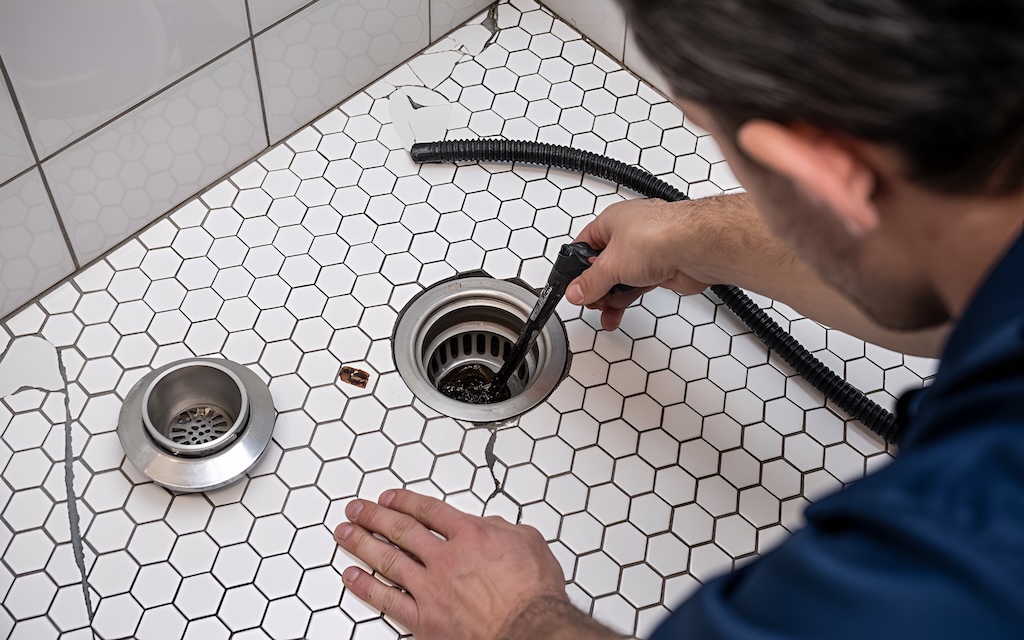
A drain cover cleaner or a basic plumber’s hair snake (available at hardware stores for around $20–$30) can be effective for surface-level build-up in the visible section of the drain. Remove the drain cover, insert the snake, and manually pull out hair and debris.
This is worth trying first on a bathroom drain that’s slowing, it’s the most common cause, and the fix is straightforward.
For a Slow Kitchen Sink
Flush with boiling water. This can soften grease build-up in the drain and shift it further along the pipe, where it can disperse. Don’t use boiling water on PVC plastic drains, very hot water can soften them. For PVC, use hot tap water instead.
Avoid chemical drain cleaners. They’re caustic, often ineffective on solid blockages, and can damage older pipes and rubber seals over time.
What to Avoid
- Don’t use a plunger aggressively on a slow drain: it can push a partial blockage deeper into the pipe, where it’s harder to reach
- Don’t ignore a slow drain that isn’t responding to basic clearing: it will become a blocked drain.
- Don’t pour grease or food waste down any drain, even with running water: it coats the inside of pipes regardless.
When to Call a Plumber
Call a licensed plumber for a slow or blocked drain when:
- Basic clearing hasn’t improved the flow in the short term
- The problem returns quickly after you’ve cleared it
- Multiple fixtures are slow or blocked at the same time
- You notice foul smells from drains that don’t improve
- There’s a backflow of water from one drain when using another
- The toilet is involved: toilet drain blockages are harder to shift without professional tools
What a Plumber Will Do
A plumber dealing with a slow or blocked drain has several approaches available, depending on the severity and location of the problem.
High-pressure water jetting is the most effective tool for clearing the full bore of a drain pipe. A pressurised water jet is fed into the pipe and clears the full internal circumference, not just a channel through the middle of a blockage. It’s effective on grease, scale, hair accumulation, and root intrusion.
Electric drain snaking uses a motorised cable to break up or retrieve a blockage. It’s particularly useful for solid obstructions close to the fixture.
CCTV drain camera inspection feeds a small camera into the drain line, allowing the plumber to see exactly what’s causing the restriction and where. This is the definitive tool for diagnosing recurring blockages, root intrusion, collapsed sections, or issues that aren’t resolved by jetting alone.
How to Prevent Drain Problems in the First Place
A few consistent habits significantly reduce the frequency of drain problems.
In bathrooms:
- Use a drain hair catcher and clear it after every shower
- Don’t pour anything down the basin drain other than water and soap
- Flush drains monthly with hot water
In the kitchen:
- Scrape plates into the bin before washing: don’t rely on running water to flush food debris
- Never pour cooking fat, oil, or grease down the sink
- Run hot water for 30 seconds after using the kitchen sink
For the whole home:
- Schedule a professional drain inspection every 2–3 years if your home has mature trees nearby or an older drain system
- Address slow drains promptly: they don’t clear themselves
Frequently Asked Questions
Is a slow drain always a sign of a blockage forming? Not always, but it’s the most common explanation. Slow drainage is a restriction, whether from build-up, a partial blockage, or a pipe issue, and it will generally worsen over time if not addressed.
Can a slow drain fix itself? Rarely. Build-up accumulates progressively. What’s slow today becomes blocked tomorrow. The exception is a one-off event that temporarily restricts flow and then clears, but even then, it’s worth investigating why it happened.
How do I know if the blockage is in my pipes or the council’s sewer line? If the blockage affects all drains in your home simultaneously and a plumber finds no obstruction within your private drains, the issue may be in the shared sewer infrastructure. Your plumber can confirm this with a CCTV inspection and advise on how to report it to Sydney Water.
How much does it cost to unblock a drain in Sydney? Cost varies based on the severity and location of the blockage. A simple jet clean is typically less expensive than a CCTV inspection with root cutting. A licensed plumber will assess the situation and provide a clear quote before starting work.
Why does my drain smell bad even though it’s not blocked? Foul smells from drains without a blockage are often caused by dry or degraded P-traps (the curved pipe section under the drain that holds water and blocks sewer gas), or build-up on the drain walls below the water line. Running water regularly and cleaning the drain cover area usually helps.
Got a Slow Drain or a Full Blockage in Sydney?
Whether you’ve got a slow shower that’s been bothering you for months or a drain that’s backed up completely, the ServiceFox plumbing team can diagnose and fix it fast.
We use professional drain cameras and high-pressure jetting equipment to find the problem and clear it properly, not just poke a hole through the middle of it.
Contact ServiceFox for fast, effective blocked drain repairs across Sydney and the Central Coast.